This is the best of what to do in Sarajevo, arranged into two days that you can actually walk and ride. The centre is small. Five hundred years of history sit within a few hundred metres of each other, the best views are a short climb away, and the story of the 1990s is told in a handful of places that each take an hour or so. That is the whole reason a plan like this works.
In this guide
It is the order we would suggest to a friend: one day on foot in the middle of town, one day out in the hills and at the edge of the city. The walking times are real, and where prices or hours change often it is worth checking on the day. If you are short on time, skip to the one-day version below.
Before you start
Most lists of things to do in Sarajevo give you thirty entries and no order. This one gives you about a dozen, in a sequence that does not make you backtrack.
Where to stay. For two days, sleep in or near Baščaršija, the old town, or on the flat streets around Ferhadija just west of it. Either way you can walk to everything on day one and be back at your door within minutes after dinner. We go through each neighbourhood, including the steep hillside ones to avoid with luggage, in our guide to Sarajevo or Mostar.
Getting around. Day one is entirely on foot. For day two you want wheels: a taxi, a driver, or the old Line 3 tram out to Ilidža for Vrelo Bosne. The airport tunnel museum is the one stop that is awkward without a car.
What it costs. Sarajevo is cheap by European standards, and most of the sights are inexpensive. Prices change, so treat these as a guide: the War Childhood Museum charges about 15 KM for an adult, the Tunnel of Hope 20 KM, and a mosque visit is a few KM. The cable car is the biggest single item at about 30 KM return for a foreign visitor. The park at Vrelo Bosne charges a token fee. Cash is still useful at the smaller sites.
If you only have one day
Do the first half of day one and the last. Baščaršija and the Gazi Husrev-beg Mosque in the morning, the Latin Bridge and ćevapi for lunch, one museum (the War Childhood Museum is the quickest), then the climb to the Yellow Fortress for sunset. You will miss the Tunnel of Hope and the cable car, but you will have seen the heart of the city.
Day 1: the old town and the line between East and West
Morning: Baščaršija and the great mosque
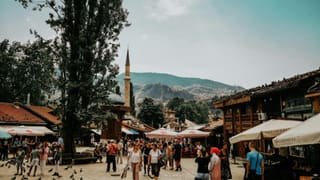
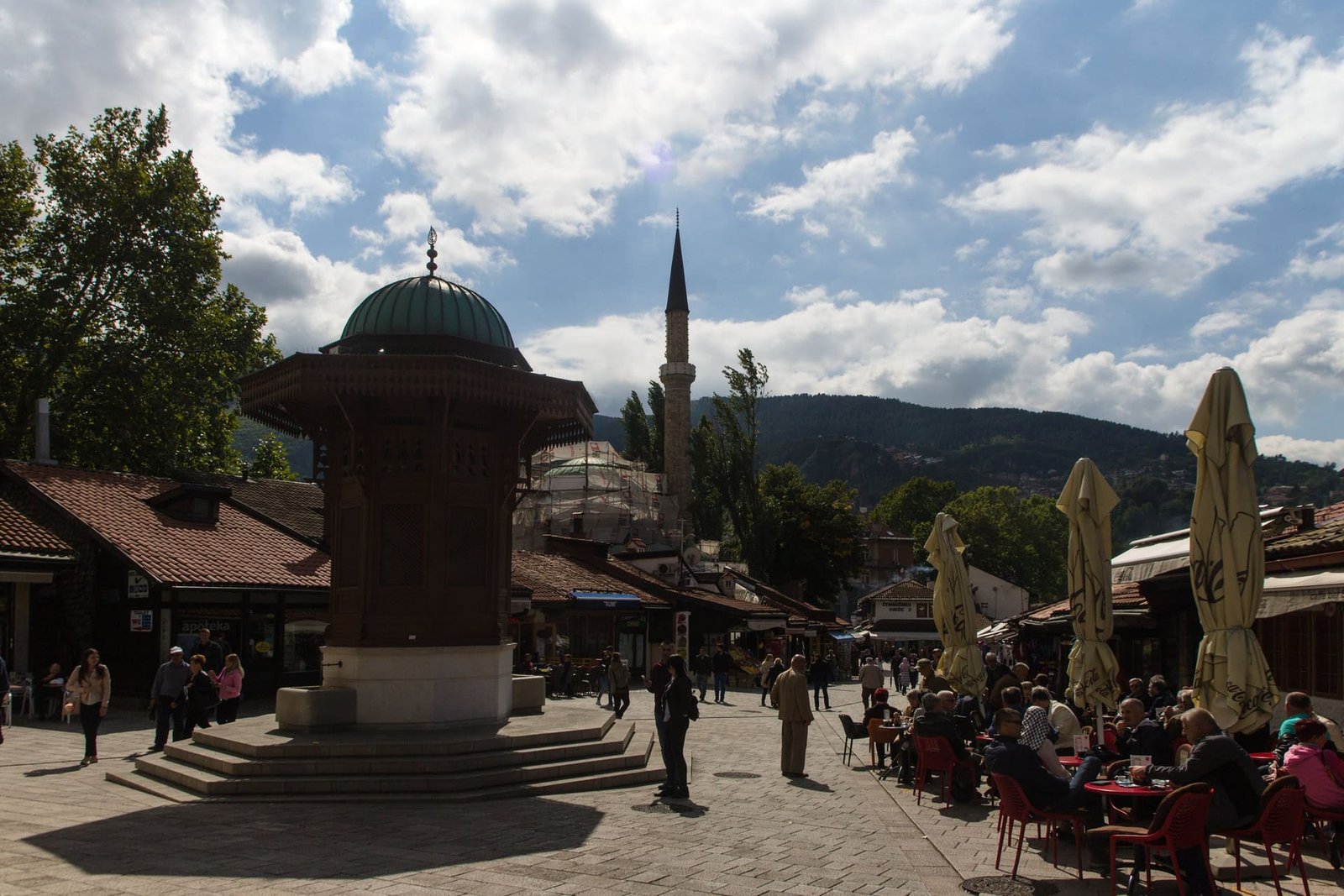
Start early, before the tour groups, in the little square at the heart of Baščaršija. The pigeons, the wooden Sebilj fountain and the smell of coffee roasting are all here by eight. The fountain you see is a copy from 1891 of an older one that burned, which is typical of Sarajevo: nothing is quite as old as it looks, and everything has been rebuilt at least once.
Have breakfast the local way, a slice of burek with a glass of yoghurt, or a pita at one of the old bakeries, then wander the lanes behind the square. The street of the coppersmiths, Kazandžiluk, is a few steps away, and the hammering starts when the shops open. Buy a small coffee set only if you intend to carry it; the lanes are better for looking than for shopping.
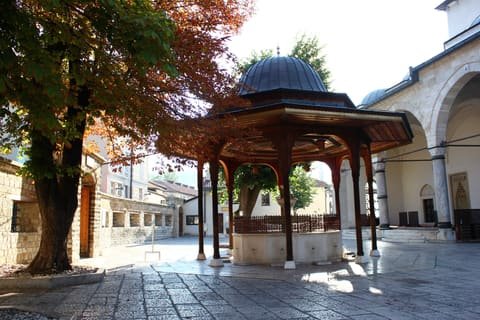
From the Sebilj, the Gazi Husrev-beg Mosque is a five-minute walk along Sarači street. Built around 1531, it is the largest historic mosque in the country and still very much in use, with a courtyard fountain and a clock tower beside the minaret. Visitors are welcome between prayers. Cover shoulders and knees, take your shoes off at the door, and women should have a scarf. If you arrive and the doors are closed, it is prayer time, so come back in half an hour.
Late morning: the Latin Bridge
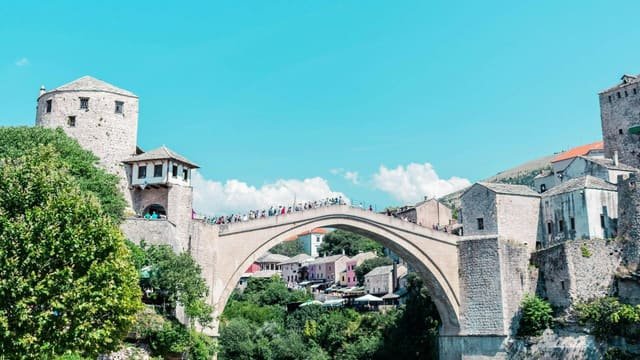
Before you leave the old town, take two minutes to walk east to the river and see the Vijećnica, the striped red-and-yellow City Hall at the far end of Baščaršija. It held the national library until it burned in 1992, and it has been rebuilt to every last tile. Then turn back and follow the river west for about five minutes to the Latin Bridge. It is small, almost shy, and you could cross it without noticing. On 28 June 1914 Gavrilo Princip shot Archduke Franz Ferdinand at the corner beside it, a moment that helped set off the First World War. There is a small museum on the corner and a plaque, and it is worth a quick look for the photographs alone.

Midday: lunch, and the line on Ferhadija
For lunch, go back toward the old town and eat ćevapi, the small grilled sausages in flatbread with raw onion and a spoonful of kajmak, a soft cream cheese. Every grill claims to be the best, and the honest answer is that the competition is close. Order a portion of ten rather than five if you are hungry, and drink a glass of cold water with it, not a soft drink.
After lunch, stroll west onto Ferhadija, the pedestrian street that marks the join between two cities. Somewhere along it a line is set into the paving and labelled the Meeting of Cultures. East of it is the Ottoman town you have just spent the morning in, low and tight and woven around the market. West of it the streets widen and the buildings turn to Austro-Hungarian stone, the way Vienna built when it took over in 1878. Step across and the whole mood changes in one stride.
At the western end stands the neo-Gothic Sacred Heart Cathedral, finished in 1887. A few streets further, you will find the Orthodox cathedral and the synagogue, which is why Sarajevo has long been called the Jerusalem of Europe. The walk from the Sebilj to the cathedral is about ten to twelve minutes if you do not stop, and you will stop.

Afternoon: the siege and the War Childhood Museum
Set aside the middle of the afternoon for the part of the story that shapes every conversation in the city. From April 1992 to February 1996, Sarajevo was under siege for nearly four years, the longest siege of a capital city in modern warfare. You do not need to visit every museum, but you should visit one, and there are two good choices within a short walk.
The War Childhood Museum, on Logavina street, is built from the objects and short testimonies of people who grew up during the war: a toy, a pair of shoes, a letter. It is small and quiet and it hits harder than most big museums. Its own website lists daily opening from 11:00 to 19:00, with last entry 30 minutes before closing, and an adult ticket at about 15 KM.
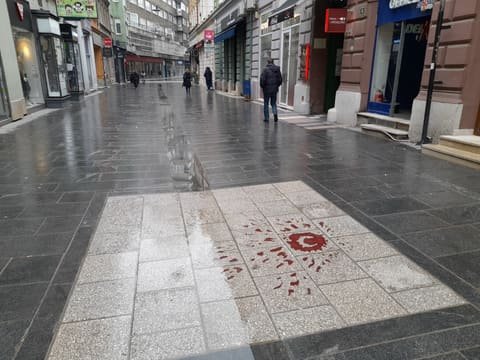
The Gallery 11/07/95, in an Austro-Hungarian building near the cathedral, is a photographic and audio exhibition about the genocide at Srebrenica, in July 1995. It is heavier and more direct. Most visitors take one or the other, depending on mood, and that is a perfectly reasonable way to do it. Keep an eye out, too, for the Sarajevo Roses on the pavements: mortar scars filled with red resin, a quiet memorial that you will keep noticing for the rest of the trip.
Evening: sunset at the Yellow Fortress (Žuta tabija)
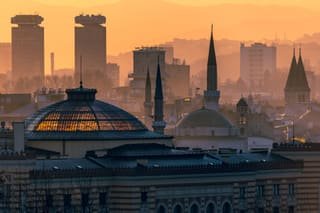
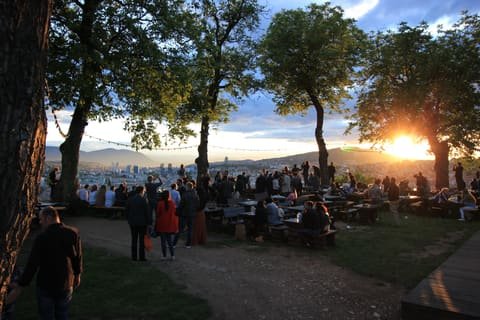
Leave an hour and a half before sunset. From the old town it is a steady uphill walk of about twenty minutes through the Kovači and Vratnik neighbourhoods, past rows of white gravestones, to the Yellow Fortress, or Žuta tabija. Locals come up here with a bottle of something and a blanket. The whole valley opens below you, the minarets lit pink and then grey, and when the sun drops behind the hills the evening call to prayer rises from every direction at once. Bring a light jacket, because it gets cooler fast.
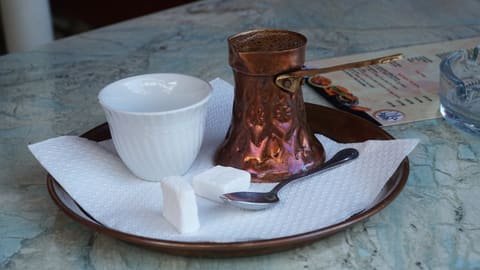
Walk back down for dinner in Baščaršija, or have a plate of grilled lamb or a hearty stew in one of the restaurants on the side streets, and finish with a Bosnian coffee, served in a small copper pot with a sugar cube and a sweet on the side, poured into little cups. It is meant to be sipped for half an hour, not drunk.
Day 2: the hills, the tunnel and the river
Day two goes beyond the centre, to places that explain how the siege worked and to the quieter side of the valley. If you would rather not sort out transport, our Spirit of Sarajevo tour covers the outlying sights door to door in a single day, with someone who can answer the questions that come up at the tunnel. If you are doing it yourself, the plan below works with a taxi.
Morning: the Trebević cable car and the Olympic bobsled track
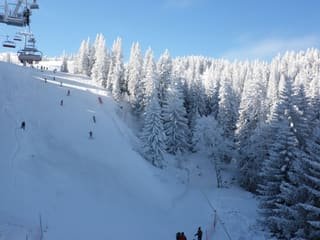
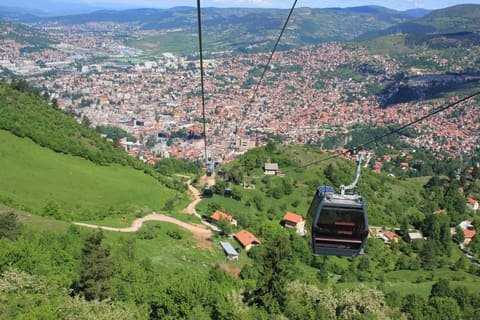
Be at the lower station on Hrvatin street, a few minutes' walk across the river from the Vijećnica, when it opens. In the summer schedule the ride runs from about 10:00 on weekdays and 9:00 at weekends, but the hours are shorter in autumn and winter, so check before you set your alarm. The Trebević cable car, which was rebuilt and reopened in 2018 after being destroyed in the war, lifts you about 2 km to 1,160 metres in under ten minutes. The valley falls away beneath your feet and the city becomes a map.
At the top, the pine forest smells like a different country. A short walk leads to the Olympic bobsled track, built for the 1984 Winter Games and abandoned after the siege, when the hillside was a front line. Concrete curves sweep through the trees, covered in layers of graffiti. You can walk the concrete in places, but the area was mined in the war and demined only in recent years, so stay on the marked paths and do not wander off into the trees. Give it an hour, or two if you want to walk the full length of the run.
Take the cable car back down for a late lunch, and call a taxi for the afternoon.
Afternoon: the Tunnel of Hope (Tunel spasa)
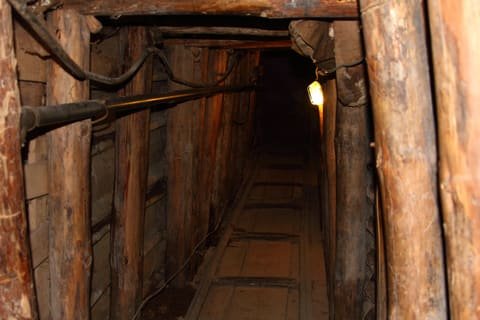
The Tunnel of Hope is on the far side of the airport, roughly 12 km from the old town, and it is the most important single site for understanding how the city survived. During the siege, Sarajevo was cut off, with the airport runway between it and the free territory. In 1993, over four months, diggers working in secret dug a tunnel under the runway, about 340 metres long and so low that adults walked bent over. Food, weapons, and people moved through it. Some of the wartime route is on show in the house where it came out, and the museum has a film, uniforms and equipment. Only a short stretch is open to walk through, which is enough to feel how narrow it was.
Plan for about an hour. Opening hours change with the season, roughly 9:00 to 17:00 or 18:00 in summer and shorter in winter, so check before you go. Bring KM in cash for the entrance.
Late afternoon: Vrelo Bosne and the Roman Bridge
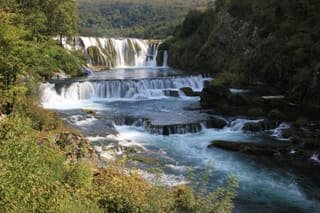
For the last stop, we like to finish somewhere green. Vrelo Bosne, the source of the Bosna river, is about fifteen minutes by car from the tunnel and sits at the foot of Mount Igman. A long, flat avenue of plane trees, about 3 km, leads from the edge of Ilidža to the springs, where clear water boils up out of the ground into pools full of ducks and swans. You can walk it or ride a horse-drawn carriage down the avenue. A small entry fee applies. Walk to the spring, sit with a coffee, and let the day settle.
Nearby, downstream on the Bosna in Ilidža, the Roman Bridge is a small humpbacked stone bridge from the sixteenth century. It was built with stones from a Roman-era predecessor and so the name stuck. It is not dramatic, but it is old, and almost nobody else is there.
Go back to town by taxi, or take the tram, which runs from Ilidža back to Baščaršija in about 40 minutes. Eat a late dinner somewhere in the centre, and you are done.
With a third day
Three days takes the pressure off the list of things to do in Sarajevo and opens up a day trip. The most popular choice is Mostar and the Neretva valley, which is about two hours away; our guide to the Mostar day trip from Sarajevo explains the route and the stops. If you prefer a quieter day, Travnik and Jajce are old royal towns of Central Bosnia, and historical sites from Sarajevo lists more places in reach. Or simply stay and use the spare day for the museums and cafes you had to skip, or for a second look at the places that caught your eye.
Planning notes
- Season. May-June and September-October are the easiest months for a walking trip. Our guides to the best time to visit Bosnia and to Bosnia in winter cover the rest of the year.
- Check before you go. Opening times for mosques, the cable car and the tunnel museum change with the season, prayer times and public holidays. Look at the official sites a day ahead, especially in winter.
- Money. The currency is the convertible mark, KM. Cards are accepted in most of the centre, but smaller museums and some parks take cash only.
Need a hand with the logistics?
If you want day two done door to door, or an airport transfer that gets you to the old town without a fuss, tell us your dates and we will suggest a plan that fits. You can also browse all our tours.
Header photo: Alexey Komarov / Wikimedia Commons (CC BY-SA 4.0)
Frequently Asked Questions