Most visitors to Bosnia point themselves south, toward Mostar and the Herzegovina sun. Head west instead and the country opens up in a different way: green river valleys, wooded hills, and two old towns that quietly hold more history between them than almost anywhere else in the Balkans. Travnik and Jajce are an easy day from Sarajevo, and together they make one of our favourite outings of the year.
This is the short version of what we tell guests before we set off: where you are going, why it matters, and what not to miss once you are there.
Travnik: the town of viziers
An hour and a half west of Sarajevo, tucked into a narrow valley beneath the Vlašić mountain, Travnik spent a century and a half as the most important town in the country. From the late 1600s it was the seat of the Ottoman governors of Bosnia, the viziers, and that long stint as a provincial capital left it with a density of mosques, fountains, and old stone houses that feels outsized for a town this small.

Its most photographed building is the Šarena Džamija, the "Colourful Mosque", its façade hand-painted with flowers and scrollwork and a small covered bazaar built into the floor below it - an unusual arrangement you will not see elsewhere. Climb a little higher and the old fortress watches over the rooftops, its tower open for the view down the valley. Down at the western edge of town, Plava Voda ("Blue Water") is where locals go to slow down: a clear mountain stream running under little bridges, lined with cafes and grill houses where the trout is about as fresh as it gets.
Travnik is also a literary pilgrimage of sorts. The novelist Ivo Andrić, the only writer from the region to win the Nobel Prize, was born here in 1892, and his "Bosnian Chronicle" is set among the foreign consuls who once schemed in these streets. The house of his birth is now a small museum. If you only have an hour, spend it walking from the mosque to Plava Voda with a coffee in hand - that is Travnik at its best.
Jajce: a waterfall in the middle of town
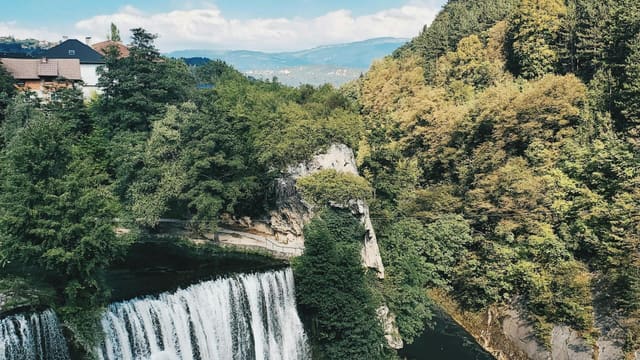
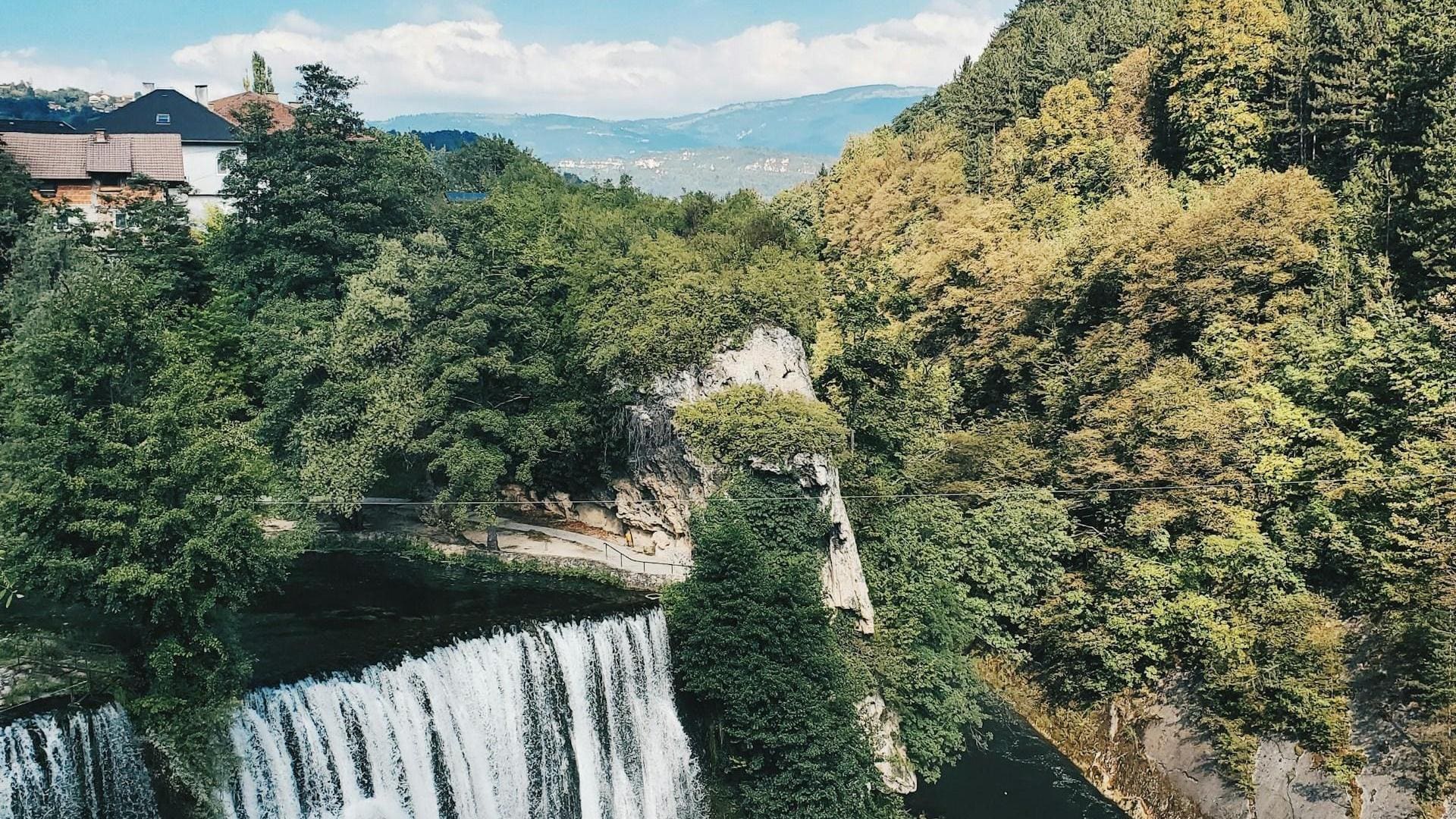
Another hour west, the road delivers you to Jajce, and the first thing you see is the thing everyone comes for. Right where the Pliva river meets the Vrbas, a waterfall some 20 metres high drops straight through the centre of the old town - one of very few places in the world where a fall like this sits in the middle of an inhabited city. There is a viewing platform at the bottom, and in spring, when the river is high, you feel the spray before you reach it.

The waterfall would be reason enough, but Jajce is layered with history the way few towns are. Its hilltop fortress crowns a knot of steep cobbled lanes, and it was here, in the Church of St Mary, that the last king of Bosnia was crowned in 1461, only for the medieval kingdom to fall to the Ottomans two years later. Below ground you can visit the catacombs, a cool underground church carved out of the rock, and a rare Roman temple to Mithras dating back some seventeen centuries. Five hundred years later, history was made here again: in November 1943, in a modest hall in the town, the decision was taken to rebuild Yugoslavia as a federation - a moment the small AVNOJ museum still marks today.
It is a lot to pack into a town you can walk across in fifteen minutes, which is rather the point. Jajce rewards slowing down and looking up.
The Pliva Lakes and the watermills
Just west of Jajce, the Pliva river widens into two lakes - the Big and the Small - ringed by forest and popular in summer for swimming, kayaking, and lazy afternoons on the shore. The reason photographers come, though, is the cluster of tiny wooden watermills strung across the water between the two lakes. Built centuries ago to grind the valley's grain, the Mlinčići are a postcard come to life: a row of little timber huts perched over the rushing channels, greenery on every side.

It is a five-minute drive from the centre of Jajce and an easy, flat walk once you are there. Bring swimming things in summer; in autumn, just bring a camera and a slow pace.
Making a day of it
Travnik and Jajce sit on the same road west of Sarajevo, which is what makes the pairing so natural. A typical day looks like a mid-morning in Travnik, the scenic hour through the valleys to Jajce, lunch by the water, and the afternoon split between the old town and the lakes before the drive home. You will be back in Sarajevo for dinner.
The one catch is logistics. Buses serve both towns, but their timetables are built for commuters, not sightseers, and the lakeside watermills sit just beyond where public transport reaches. If you are comfortable on Bosnia's two-lane roads, a rental car gives you the freedom to stop wherever the view demands it. If you would rather leave the driving and the history to someone who knows the route, that is exactly what our Central Bosnia day tour is built around - Travnik, Jajce, and the Pliva Lakes in one unhurried day from Sarajevo, with a local guide to fill in the stories. We also run private transfers across the country if you simply want a comfortable ride from one town to the next.
Tip: if you can only choose one season, come in late spring. The waterfall is at full roar, the hills are at their greenest, and the summer day-trip crowds have not yet arrived.
Central Bosnia is the part of the country most visitors skip, and that is precisely its charm. Give it a day and you will come back with a very different picture of the place - older, greener, and quieter than the postcards of the south. When you are ready, browse all our tours or tell us what you would like to see, and we will build the day around you.
Frequently Asked Questions