Few cities pack as much history into as little space as Sarajevo. Within a few hundred metres you can stand where the Ottoman bazaar still trades the way it has for five centuries, cross the bridge where the shot that started the First World War was fired, and look up at an Austro-Hungarian city hall that became a wartime ruin and then rose again. But the country's story does not stop at the city limits. Spread out around Sarajevo, often within an easy day's drive, are the other chapters: a Roman crossing, a medieval royal town, Ottoman strongholds, a secret Cold War bunker, and the bridges that have come to stand for the whole country. Here is where to find them, and how far each one really is.
Start with the history inside Sarajevo
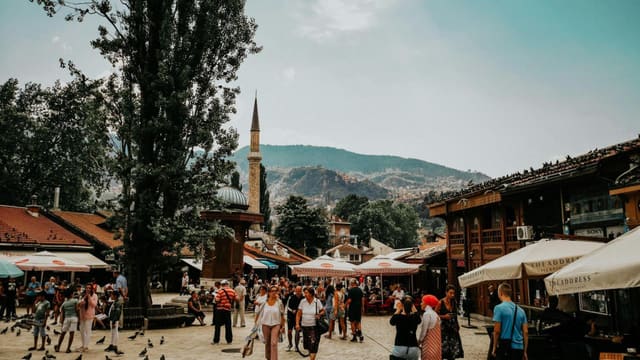
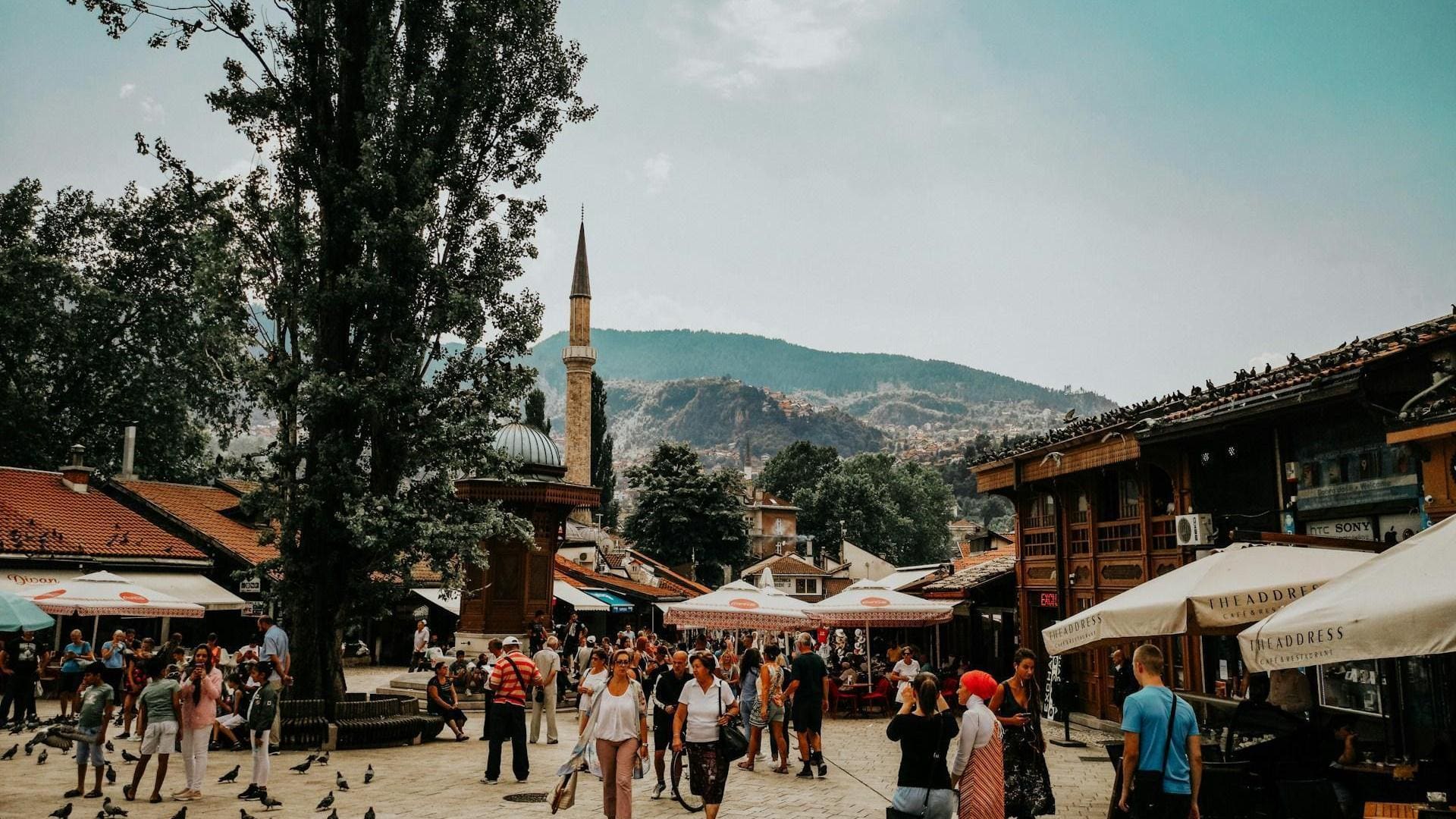
Before you go anywhere, the city itself is the best history lesson in Bosnia. Bascarsija, the old bazaar laid out in the 15th and 16th centuries, is still the beating heart of the Ottoman town, complete with the Sebilj fountain and the 1531 Gazi Husrev-beg Mosque. A few minutes' walk away, the Latin Bridge marks the spot where Archduke Franz Ferdinand was assassinated in June 1914, the spark for the First World War. Closing the picture, the striped City Hall (Vijecnica), a pseudo-Moorish jewel of the Austro-Hungarian period, served as the national library until it burned in 1992 and was painstakingly rebuilt by 2014. You can walk all of this in an afternoon, and our Spirit of Sarajevo tour joins the threads together.
The Tunnel of Hope
On the edge of the city, beneath the airport, lies the most moving historical site in Sarajevo. During the siege of the 1990s, the city was cut off on every side, and a hand-dug tunnel running roughly 800 metres under the runway became its single lifeline for food, fuel, and people.

A preserved section is now the Tunnel of Hope museum, in the Ilidza district about fifteen minutes from the centre. Walking the surviving stretch, low and cramped, with the original rails and props still in place, tells you more about the siege than any number of photographs. It is the natural first stop for anyone trying to understand the city's recent past.
The Roman Bridge and Vrelo Bosne
Keep going into Ilidza and the timeline jumps back nearly two thousand years. The Romans built a thermal settlement here around the sulphur springs, and the graceful arched crossing known as the Roman Bridge (Rimski Most) still spans the Zeljeznica river, raised from the stones of those ancient ruins.

A short walk or a horse-drawn carriage ride down the leafy Velika Aleja avenue brings you to Vrelo Bosne, the springs where the river Bosna rises in a cool fan of streams and islets at the foot of Mount Igman. The landscaped park dates to the Austro-Hungarian era and is one of the locals' favourite escapes. Together the bridge and the springs make a gentle half day that barely counts as leaving the city.
Konjic: an Ottoman bridge and Tito's secret bunker
An hour south of Sarajevo on the road to Mostar, the little town of Konjic hides two very different pieces of history. Its elegant six-arched Ottoman stone bridge dates from the 1680s, was destroyed in the Second World War, and was faithfully rebuilt by 2009.

The town's stranger claim to fame sits in the hills above it: ARK D-0, a vast nuclear bunker built in secret over decades for Marshal Tito and the Yugoslav leadership, hidden behind an ordinary-looking house and only revealed to the public this century. It now doubles as a contemporary art space. Konjic is an easy stop on any trip toward Herzegovina, and our private transfers can fold it into the drive south.
Travnik: the town of viziers
About ninety minutes northwest of Sarajevo, Travnik was for nearly two centuries the seat of the Ottoman governors of Bosnia, which earned it the nickname of the European Istanbul. The legacy is everywhere: a hilltop medieval fortress looking down over the town, the beautiful Many-Coloured Mosque (Sarena Dzamija) with its painted facade, and the clear spring of Plava Voda where locals still gather.

Travnik is also the birthplace of Ivo Andric, the only Bosnian winner of the Nobel Prize in Literature, whose novels are steeped in these streets. It pairs naturally with Jajce further on, and the two together are the backbone of our Central Bosnia tour.
Jajce: the medieval royal city
If you visit only one place for the medieval Bosnian kingdom, make it Jajce, around two and a half hours northwest of Sarajevo. This was the last capital of independent Bosnia, where the final king, Stjepan Tomasevic, was crowned before the Ottomans took the town and executed him in 1463.

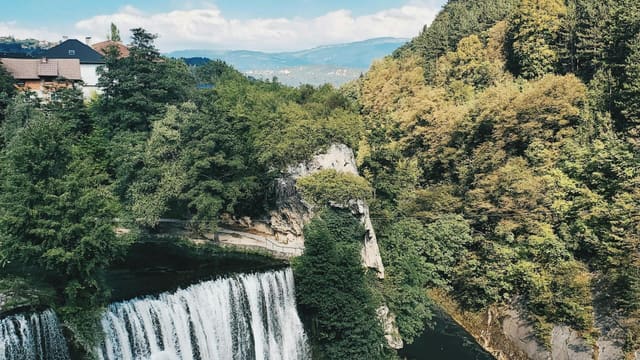
The old town climbs to a commanding fortress, and below it you will find eerie underground catacombs, a tower from the church of St Luke, and a 20-metre waterfall thundering right through the centre of town, one of the few in the world inside an urban core. Jajce holds modern history too: in 1943 the second session of AVNOJ met here and laid the foundations of postwar Yugoslavia. It is a long day from Sarajevo, best combined with Travnik, or enjoyed at leisure with an overnight.
Pocitelj and Blagaj: Herzegovina's stone history
Head south past Mostar and the landscape turns to pale Herzegovinian stone, with two of the country's most atmospheric historical sites a short distance apart. Pocitelj is a fortified Ottoman-era village stacked up a hillside above the Neretva, crowned by a fortress and a tall clock tower, its stepped lanes and 16th-century mosque looking much as they did four hundred years ago.

Nearby Blagaj holds one of the most photographed sights in the country: a white dervish monastery (tekija) from around 1520, tucked under a towering cliff right at the spot where the Buna river surges out of the rock. Both sit south of Mostar and are usually visited together on a day exploring Herzegovina.
Mostar: the bridge that became a symbol
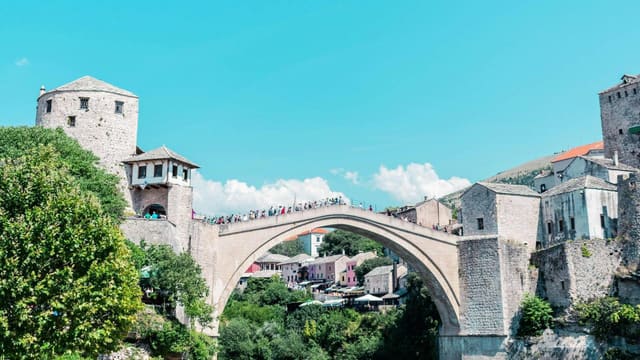
No tour of Bosnia's history is complete without Mostar, about two hours south of Sarajevo. Its famous Stari Most, the Old Bridge, was built by the Ottoman architect Hayruddin in 1566 and arched over the green Neretva for more than four centuries until it was shelled into the river in 1993.

Rebuilt stone by stone and reopened in 2004, it is now a UNESCO World Heritage Site and a symbol of a country putting itself back together. The old bazaar around it, the divers who leap from its parapet in summer, and the views along the river make Mostar the natural climax of a history-minded trip through the south. Our Grand Herzegovina tour links it with Blagaj, Pocitelj, and the Kravice waterfalls in a single day from Sarajevo.
Seeing them without the logistics
The beauty of Sarajevo is that so many layers of history sit within a day of it, but stitching them together by bus and train takes patience and a flexible schedule. If you would rather spend the day looking at the sites instead of timetables, we can help. Join our Spirit of Sarajevo tour for the city itself, the Central Bosnia tour for Travnik and Jajce, or the Grand Herzegovina tour for Mostar and the south. Prefer to go at your own pace, with stops of your choosing? A private transfer or a custom day lets you build the history trip you actually want - just tell us which chapters matter most to you.
Frequently Asked Questions