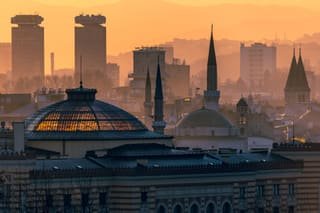
For two weeks in February 1984, Sarajevo was the centre of the winter sports world. Then, within a decade, the city was under siege and the places built for the Games were either burning, serving as gun positions or lying in a front line. What remains today is an uneven, quietly moving trail of concrete, ruins and a few rebuilt halls, and it is one of the most interesting things you can do here that is not in the usual old town loop.
In this guide
This guide covers the story in brief, then goes site by site: the bobsled track, the ski jumps, Zetra, the Olympic museum and Koševo, with a route that fits in one day.
The 1984 Games in a few paragraphs
The XIV Olympic Winter Games ran from 8 to 19 February 1984, with around 49 nations and nearly 1,300 athletes. Sarajevo had won the right to host in 1978, beating Sapporo by three votes. It was a first on two counts: the first Winter Olympics in a socialist country and the first in a Slavic-speaking one.
The Games were warmly remembered in Yugoslavia. The mascot was Vučko, a smiling wolf drawn by the Slovenian artist Jože Trobec and picked by newspaper readers. The home crowd got its hero on 14 February, when Slovenian skier Jure Franko took silver in the giant slalom on Bjelašnica, Yugoslavia's first ever Winter Olympic medal. And at the Zetra hall, British ice dancers Jayne Torvill and Christopher Dean skated their free dance to Ravel's Boléro and collected nine perfect 6.0 marks for artistic impression, a moment that British television still replays every few years. They came back to Sarajevo to skate it again for the 30th anniversary.
Then 1992 arrived. In the siege that followed almost every venue was damaged. Jahorina, the women's alpine mountain, came through the war largely unscathed, the only venue that did. That is why visiting the sites today is partly sport history and partly something heavier, and it is worth keeping that tone in your head as you walk around.
The Trebević bobsled track
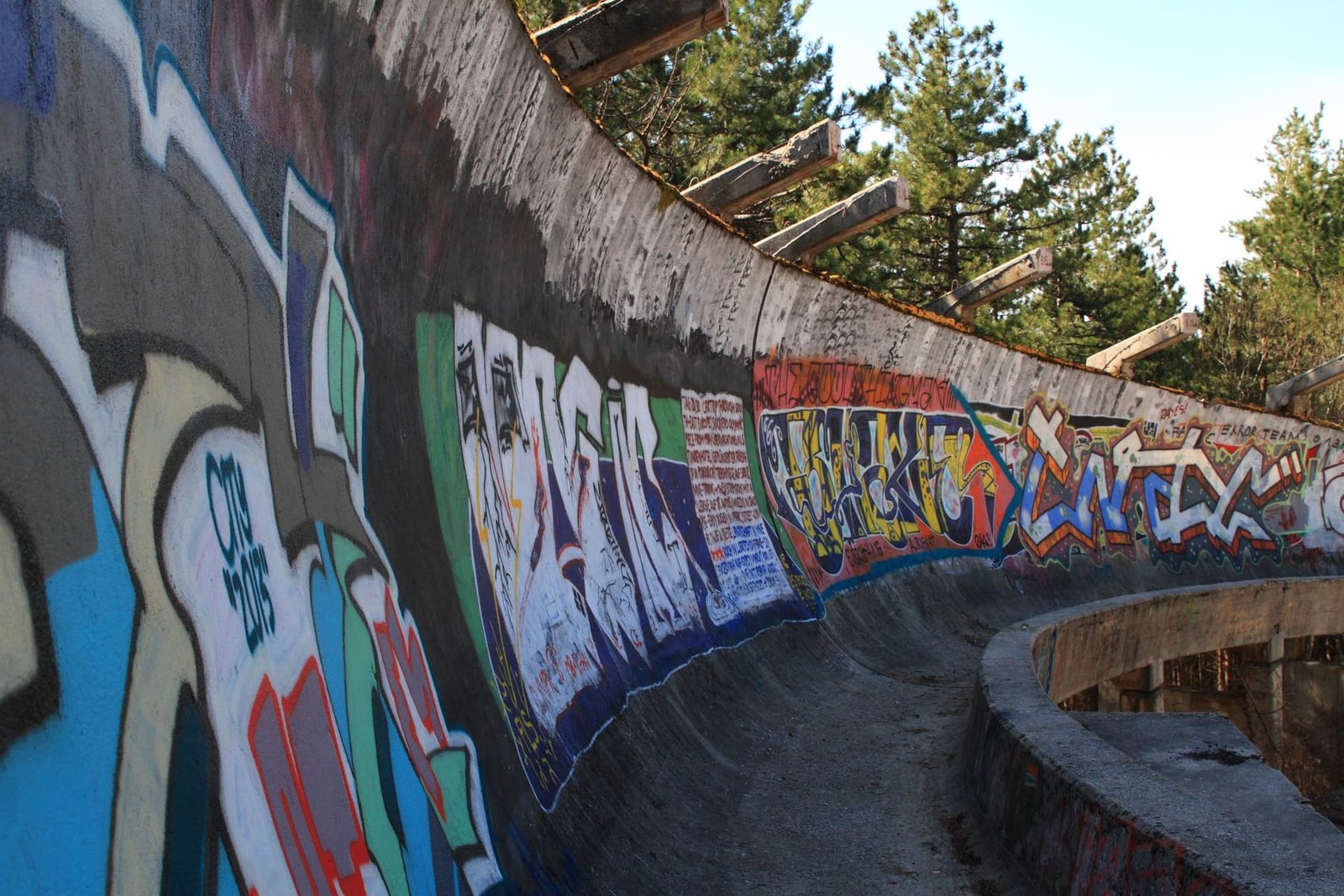
If you only see one Olympic site, make it this one. The bobsled and luge track on Trebević mountain was built between 1981 and 1982 and is a 1,300 metre ribbon of banked concrete with 13 turns and a drop of about 126 metres from top to bottom. It hosted European championships in the years after the Games, and World Cup racing until Yugoslavia broke up. During the siege, Bosnian Serb forces used the hillside as an artillery position, and you can still see the scars on the concrete.
Today it is a graffiti gallery. Layer upon layer of spray paint covers the curves, and volunteer clean-ups in recent years have cut back the worst of the overgrowth. No bobs or sleds have run on it for decades, since the refrigeration plant and start houses are gone, and a full rebuild has been talked about for years without happening.
How to get there
The easy way up is the Trebević cable car, rebuilt and reopened in 2018. The lower station is in Bistrik, a five to seven minute walk from the City Hall, and the ride takes about seven minutes, climbing from roughly 583 metres to 1,160 metres. A return ticket for visitors is 30 KM, about 15 euros. Hours vary with the season and the car stops in strong wind or for maintenance, so look at the operator's timetable the evening before.
From the top station a signposted paved road leads downhill, and the first curve of the track appears within 5 to 10 minutes. Allow 60 to 90 minutes if you want to walk a good stretch and take photographs. The surface is uneven concrete with leaf litter and puddles, and under snow or ice it can be properly slippery. Wear boots, not trainers. On a winter morning the valley below can be lost in cloud while the track sits in blazing sunshine, as described in our Bosnia in winter guide.

Safety
Mines laid during the war have not been cleared everywhere, and the hills around Trebević are among the places still marked as suspect. The track itself and the roads are safe to walk; the undergrowth is another matter. Stay on the concrete and the established paths, ignore tempting shortcuts, and do not climb the old start structures. If a path looks unused, it probably is.

The Igman ski jumps at Malo Polje
On the plateau of Igman, about 25 km from the centre of Sarajevo, stand the two ski jumps from the 1984 Games: Jens Weißflog won the normal hill here and Matti Nykänen the large hill. There has been no competition since the Olympics. A plan in 2010 to rebuild the in-runs and bring the large hill up to modern size never started, and what you see now is bullet-scarred concrete, a rusted judges' tower and the Olympic podium still in place below the hills. Igman was a buffer zone with heavy fighting during the war.
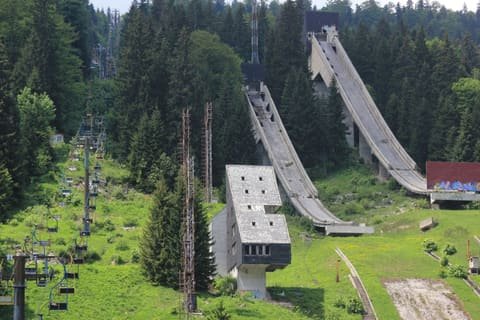
There is no public transport, so this stop needs a car or a driver. Allow around an hour on site, and treat the ground the same way as at Trebević: stay on roads and cleared paths. A mountain hut across from the jumps is a useful place for tea if the wind is up. A short walk from the jumps, the shell of Hotel Igman, which housed competitors and journalists in 1984, still stands abandoned and marked by the war. It is best seen from the road and not entered. In snow the plateau road may be slow, and in deep snow it may not be passable at all.
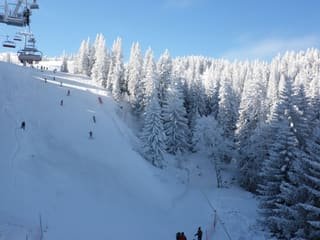
Igman today is also a modest ski area with cross-country trails and children's slopes. For the bigger mountains, see our skiing in Bosnia guide, which covers Bjelašnica and Jahorina, the two venues of the alpine events, rather than repeating it here.
Zetra and the Olympic Hall
The Zetra complex sits on Alipašina street, uphill from the centre, a short taxi ride or a 35 to 40 minute walk from the old town. It was the setting for Torvill and Dean's gold, the ice hockey final and the closing ceremony. In May 1992 the hall was shelled and burned, and beside it a wartime cemetery grew on a former football pitch. Rebuilding began in 1997 with money from the IOC, and the hall reopened in 1999. In 2010 it was renamed the Juan Antonio Samaranch Olympic Hall, after the IOC president who closed the 1984 Games. It now hosts handball, basketball, ice hockey and concerts, with seats for about 12,000.

You can look at the outside any time, and the interior is open only when there is an event, so check the programme if you want to go in. The cemetery is a place of mourning and should be treated that way.
The Olympic Museum
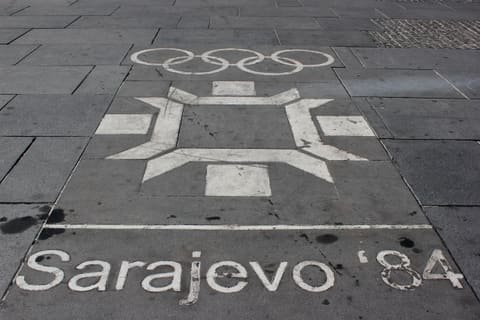
The museum opened on the first day of the Games, 8 February 1984, in the Mandić villa, an Art Nouveau house of 1903 on Petrakijina street in Mejtaš. It burned on 27 April 1992 and most of its collection was lost. What was saved moved to the Zetra complex, where a smaller museum opened in 2004, with medals, souvenirs, and the skis Jure Franko used. After years of restoration, the Mandić villa reopened as the museum on 8 October 2020, now covering both the 1984 Games and the 2019 European Youth Olympic Winter Festival.
Opening hours are limited and change through the year, so check with the Olympic Committee of Bosnia and Herzegovina before you walk across town.
Koševo stadium and the rest
The Koševo stadium, now named for the footballer Asim Ferhatović Hase, held the opening ceremony in front of about 50,000 people. It is the home ground of FK Sarajevo and still hosts big matches and concerts. It stands in the same corner of town as Zetra and the main hospital, so the two fit into one walk.
The hockey hall of Skenderija is also still in use. The outer buildings of the old Olympic village are less fortunate, with abandoned blocks scattered around the city.
A one-day route
Winter days are short, with roughly nine hours of daylight in December, so start early and put the outdoor stops first.
- Morning. Cable car from Bistrik, walk down to the bobsled track, take your time on the curves and ride down. The cable car opens later on some days, at noon on Mondays, so check the hours and swap with step 3 if needed.
- Midday. Lunch in the old town or near the lower station.
- Afternoon. Zetra, Koševo stadium and, if it is open, the Olympic Museum, all a short taxi ride from the old town.
- Igman. The jumps need a car and daylight, and the drive takes the best part of an hour each way, while December sunset comes around 4:10 pm. Give them their own morning, or go up first and do the city stops afterwards.
You can do all of this independently, apart from Igman. If you would rather have a driver and a local who knows which roads are open, we plan custom Olympic-sites days around your dates, and we run ski-resort transfers too, so Bjelašnica, Jahorina and Igman are covered by a private transfer. For the wider city, our Spirit of Sarajevo tour and things to do in Sarajevo pair well with an Olympic morning.
Tip: do the bobsled track first thing, before the cable car queue builds and before the afternoon light drops behind the ridge. The curves under fresh snow are beautiful, but only if you have a sensible pair of boots.
If a winter break is on the cards, there is more in our winter weekend in Sarajevo and Sarajevo Christmas and New Year guides. Tell us your dates and we will build the day, or browse all our Bosnia tours.
Header photo: spacebirdy / Wikimedia Commons (CC BY-SA 3.0)
Frequently Asked Questions