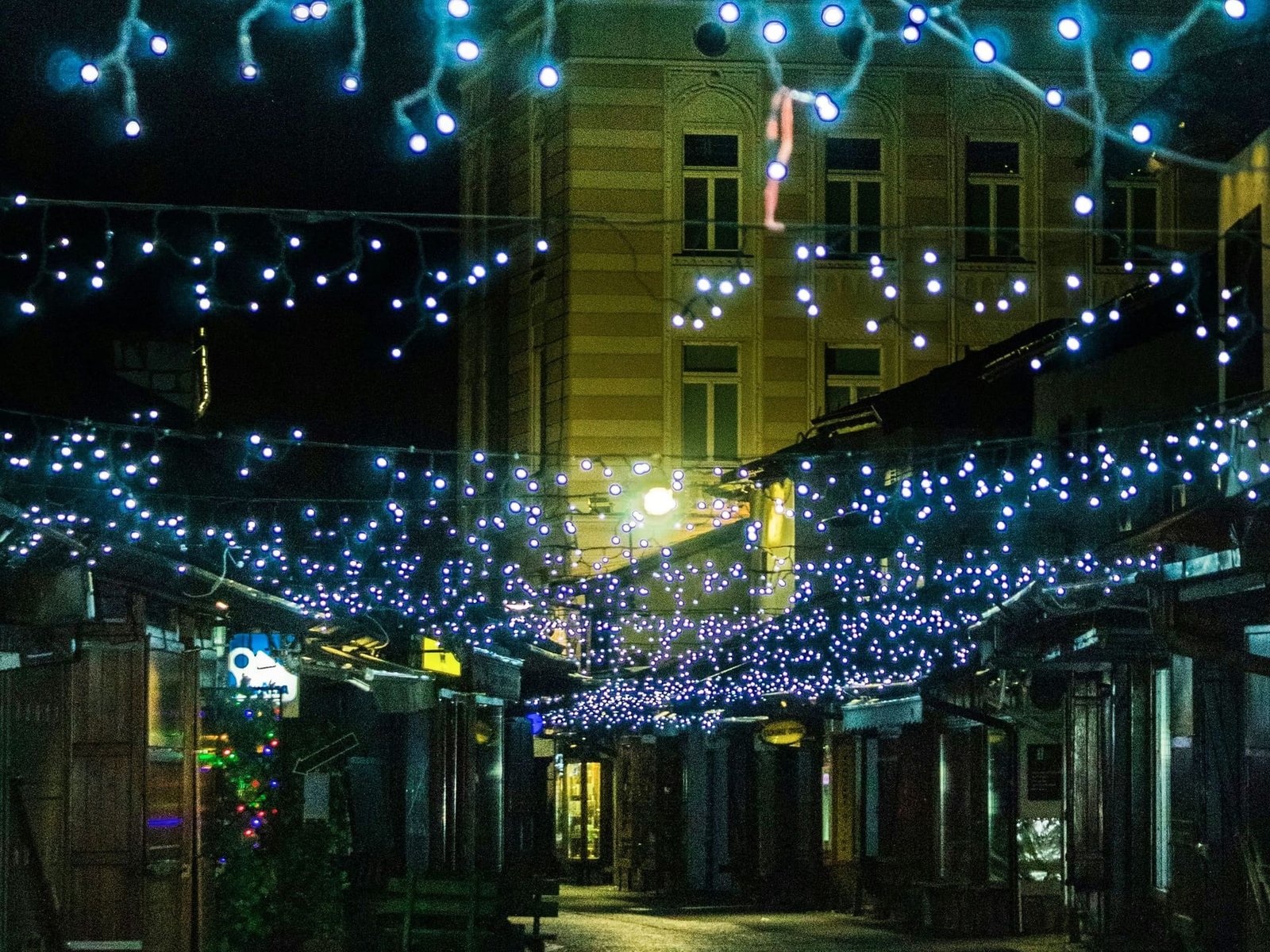
December is when Sarajevo puts on its best winter face. Strings of lights go up over the pedestrian streets, a wooden village of stalls appears along the river, the smell of grilled meat and hot wine drifts across the cold, and two Christmases and two New Years keep the city in a party mood for the best part of a month. It is also short on daylight, sometimes grey and, in still weather, smoky. This guide helps you plan the good parts and sidestep the rest. The city publishes the exact dates of the market and the concerts only a few weeks ahead, so it is worth checking the city's pages before you book anything that hangs on one particular night.
In this guide
- Sarajevo Christmas market: the Holiday Market on Wilson's Promenade
- Festive food and drink
- New Year's Eve in Sarajevo
- Catholic Christmas: 24 and 25 December
- Orthodox Christmas on 7 January and Orthodox New Year on 14 January
- What is open on 25 December, 1 January and 7 January
- Sarajevo in December: weather, daylight and air
- Prices and booking for New Year week
- Day trips over the holidays
- Planning checklist
Sarajevo Christmas market: the Holiday Market on Wilson's Promenade
The Sarajevo Christmas market goes by the name Sarajevo Holiday Market, and the "holiday" is deliberate. It has run since 2011 and is meant for everyone who celebrates something between early December and mid January. For years it sat in Hastahana Park in Marijin Dvor. In recent winters the main activity has moved to Wilson's Promenade (Vilsonovo šetalište), the tree-lined riverside walk along the Miljacka, around two kilometres west of the old town.
When it opens
It opens in the first or second week of December, usually with the lighting of the city's big New Year tree, and keeps going well into January with daily afternoon and evening performances. Confirm the exact date closer to the time.
What you find there
Expect wooden huts selling crafts, sweets and hot drinks, a stage with a daily music programme, and attractions aimed at children, which in some years have included a Ferris wheel and a Santa village. Entry is free. Carry some KM in cash for the stalls, since small sellers rarely take cards.
It is a local event first and a tourist one second. Families come after work, teenagers cluster around the stage, and nobody is in a hurry. Go in the early evening, when the lights are on and it is busy but not packed, and walk back toward the old town along the river afterwards.
The ice rink
There is usually an outdoor ice rink at the market, often free for children during the school winter holidays. It needs a cold snap, and a warm spell can close it, so ask at the information stand about hours and prices before bringing skates.
Festive food and drink
Cold evenings are for standing near something warm. At the market and on the streets around Baščaršija you will find kuhano vino, mulled wine, usually red and heavy on cinnamon, and kesten, chestnuts roasted in a drum over coals and sold in paper cones. Neither is a Bosnian invention, but both have settled in so firmly that people queue for them.
For a proper meal, look for what Bosnian kitchens do in winter: sudžuk (spicy dried beef sausage) fried with eggs for breakfast, bean stews called grah, begova čorba with chicken and okra, and sogan-dolma, onions stuffed with minced meat. On Christmas tables in Catholic and Orthodox homes you will find roast meat, sarma (cabbage rolls), and sweet breads and cakes. Muslim neighbours often bring baklava and hurmašice to the same tables. Order salep, a hot milky drink thickened with orchid root and dusted with cinnamon, at a cafe on a day when your fingers have stopped working.
New Year's Eve in Sarajevo
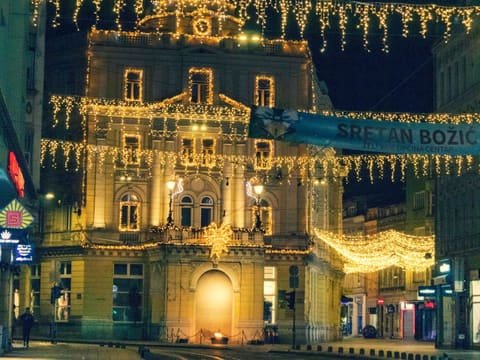
Sarajevo New Year is organised as a multi-day public party. The city puts up a main stage with free concerts, and the programme usually runs from New Year's Eve through the first days of January. The location moves: for many years it was Trg Bosne i Hercegovine in Marijin Dvor, more recently the square in front of the Vijećnica and the open ground at Vrbanja near the City Center mall, where tens of thousands of people turned out. The headliners are almost always big names from across the former Yugoslavia, and the venue and line-up are announced in December. Expect loud music and a cold wait. Bring gloves and a hat, as it is likely to be below freezing, and agree on a meeting point, since mobile networks clog when tens of thousands of people check their phones at midnight.
If crowds are not your idea of a night out, hotels and restaurants across the city hold gala dinners with live music, normally a fixed menu with a welcome drink. These sell out, so reserve weeks ahead. The mountain hotels on Jahorina and Bjelašnica do the same, and the biggest are fully booked well before Christmas.
Catholic Christmas: 24 and 25 December
Sarajevo's Catholic community gathers at the Sacred Heart Cathedral (Katedrala Srca Isusova), the twin-towered neo-Gothic church on the western end of Ferhadija. On 24 December there is an evening vigil mass and then the midnight mass, with more masses at dawn and through the day on 25 December, led by the Archbishop of Vrhbosna. The parish posts the exact times a few days ahead.
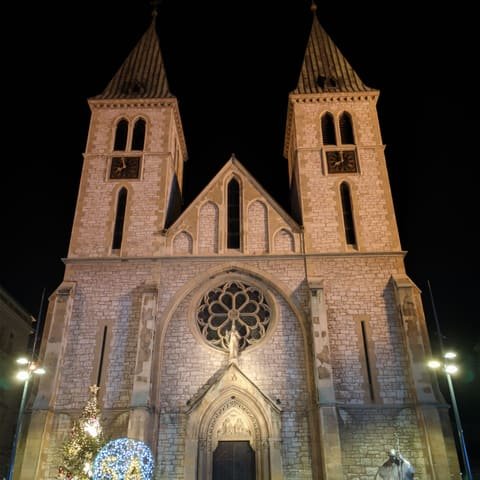
The midnight mass is open to everyone and the church fills early. Plenty of non-Catholic Sarajevans come too, and visitors are welcome if they stand quietly at the back, dress modestly and keep their phones away. Arrive well before the start, because it is standing room only by 11 pm.
Orthodox Christmas on 7 January and Orthodox New Year on 14 January
Orthodox Christians follow the Julian calendar, so their Christmas falls on 7 January. The evening before, Badnje veče, families bring in an oak branch (badnjak), which is burned in a ceremony on the street outside some Orthodox churches. In Sarajevo the main liturgy takes place at the Cathedral Church of the Nativity of the Theotokos on Liberation Square in the centre, a short walk from the Sacred Heart Cathedral. Services run through the morning of 7 January, and the greeting is Mir Božiji, Hristos se rodi, answered by Vaistinu se rodi.
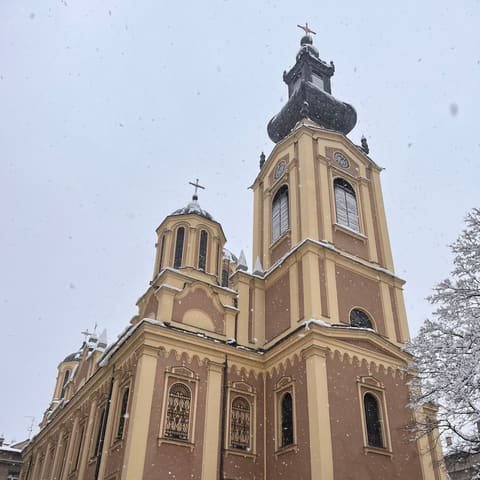
Orthodox New Year on 14 January is quieter, a family dinner night and a few concerts in the bars. It is useful mostly because the city is calm by then, rooms are cheaper than in New Year week, and the market is still running.
What is open on 25 December, 1 January and 7 January
Plan for a slow 25 December and an even slower 1 and 2 January, which are public holidays. Many shops and offices close, supermarkets and bakeries may open short hours or not at all, so buy bread and water the day before. Restaurants in the old town and in hotels carry on, as do many cafes, and the cable car and big museums keep their winter hours, though it is worth checking before you go. Orthodox Christmas on 7 January is a holiday for those who celebrate it, but most of Sarajevo works as usual.
Sarajevo in December: weather, daylight and air
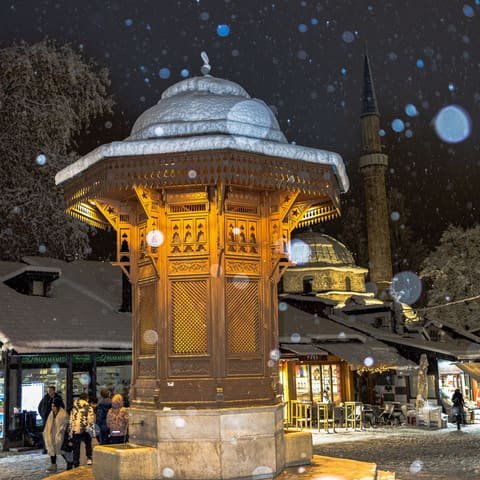
Daytime highs hover around 4 degrees in December, and nights are commonly a few degrees below freezing. Sunset is as early as 4:10 pm around the shortest day, with only a little under nine hours of light in total, so do the walking and the outdoor sights between roughly 9 am and 3:30 pm and then head indoors. Snow shows up in some weeks and not in others. Mostar, two hours south, is much milder but wetter.
December is also when the valley air is at its worst. If the day is still and freezing, smoke from heating settles over the city. Our winter pillar guide explains what to do about it, including the trick of riding the cable car above the haze, and the same guide covers what to pack. Outdoor events can be cancelled during severe smog alerts, so look at an air-quality app in the morning.
Prices and booking for New Year week
Sarajevo is still cheap by European standards, but the week from Christmas to the first days of January is the one time of year when rooms cost noticeably more, and the best places in the old town go first. Book your room as soon as your dates are fixed, and reserve a table if you want dinner out on 31 December. Flights are thinner in winter than in summer, so look at routes before fixing dates. Outside that week, December and January are among the cheapest months to be here. A private airport transfer is worth arranging in advance if you land late on a snowy night. We run transfers all year, including New Year week, so book your transfer as soon as your flight is fixed.
Day trips over the holidays
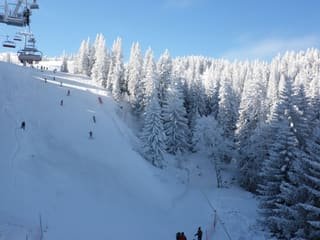
If the festive programme leaves you with a free day, two options work in December. The first is the slopes: Jahorina and Bjelašnica are around 30 km from the city and usually open once there is enough snow, which in a good year means a week or two before Christmas. Day passes for the 2026/27 season cost up to 98 KM at Jahorina and 69 KM at Bjelašnica, and our skiing guide goes into passes and rental. Midweek is quieter, and New Year week is the opposite.
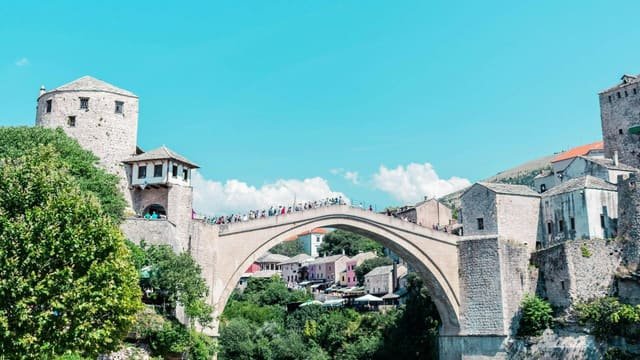
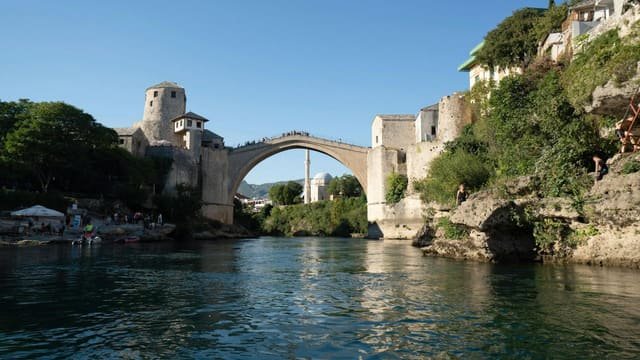
The second is Mostar. The road and the train run all winter, snow gives way to green along the Neretva, and the Old Bridge is almost empty. Read the guide to Mostar in winter for what stays open. We run all our tours through the winter, ski days and ski-resort transfers included, so a day out in December or January is a normal booking for us. You can fit the Spirit of Sarajevo tour into a short winter day, or combine the Grand Herzegovina tour with an overnight, or ask for something custom.
If you plan to stay for more than a night or two, see our winter weekend in Sarajevo for an itinerary built around the cold and the short days, and our guide to things to do in Sarajevo for the full list. History lovers will like the Sarajevo Winter Olympics guide.
Tip: if you want the market and the concerts but not the crowds, come in the second week of December or between 8 and 20 January. The lights are still up, and the bars are no longer packed.
Planning checklist
Book rooms early for 27 December to 3 January, confirm the market and concert dates when the city announces them, bring boots with real grip because the paving gets glassy, and keep one or two indoor stops in each day. Tell us your dates if you would like help shaping the days, or browse all our tours.
Header photo: Sporisevic Photography / Unsplash
Frequently Asked Questions