Bosnia and Herzegovina is a small country, and on a map it looks like you could see it in a long weekend. Then you drive it. The roads bend around mountains and follow rivers through canyons, and a hundred kilometres can take two hours - two very scenic hours, but two hours all the same. The trick to a good Bosnia itinerary is to stop fighting that and plan around two bases rather than a different bed every night.
This is the week we would plan for a friend visiting for the first time. It covers the capital, the medieval heartland, and the sunlit south, with honest travel times, and there is a five-day version further down for anyone short on time.
The route at a glance
| Day | Where | Sleep |
|---|---|---|
| 1 | Sarajevo: the old town | Sarajevo |
| 2 | Sarajevo: the siege, the cable car, the view | Sarajevo |
| 3 | Around Sarajevo: Vrelo Bosne, Tunnel of Hope, Olympic mountains | Sarajevo |
| 4 | Day trip to Travnik and Jajce | Sarajevo |
| 5 | South via Konjic to Mostar | Mostar |
| 6 | Blagaj, Počitelj, and Kravice waterfalls | Mostar |
| 7 | Slow morning in Mostar, return to Sarajevo | - |
Four nights in Sarajevo and two in Mostar. The whole loop stays inside the country, and you never drive more than about two and a half hours in one go.
Days 1 and 2: Sarajevo
Give the capital two full days. It is a small city, but a dense one: within a few hundred metres you walk from an Ottoman bazaar to Austro-Hungarian boulevards, past a mosque, a synagogue, and two cathedrals, which is why it used to be called the Jerusalem of Europe.
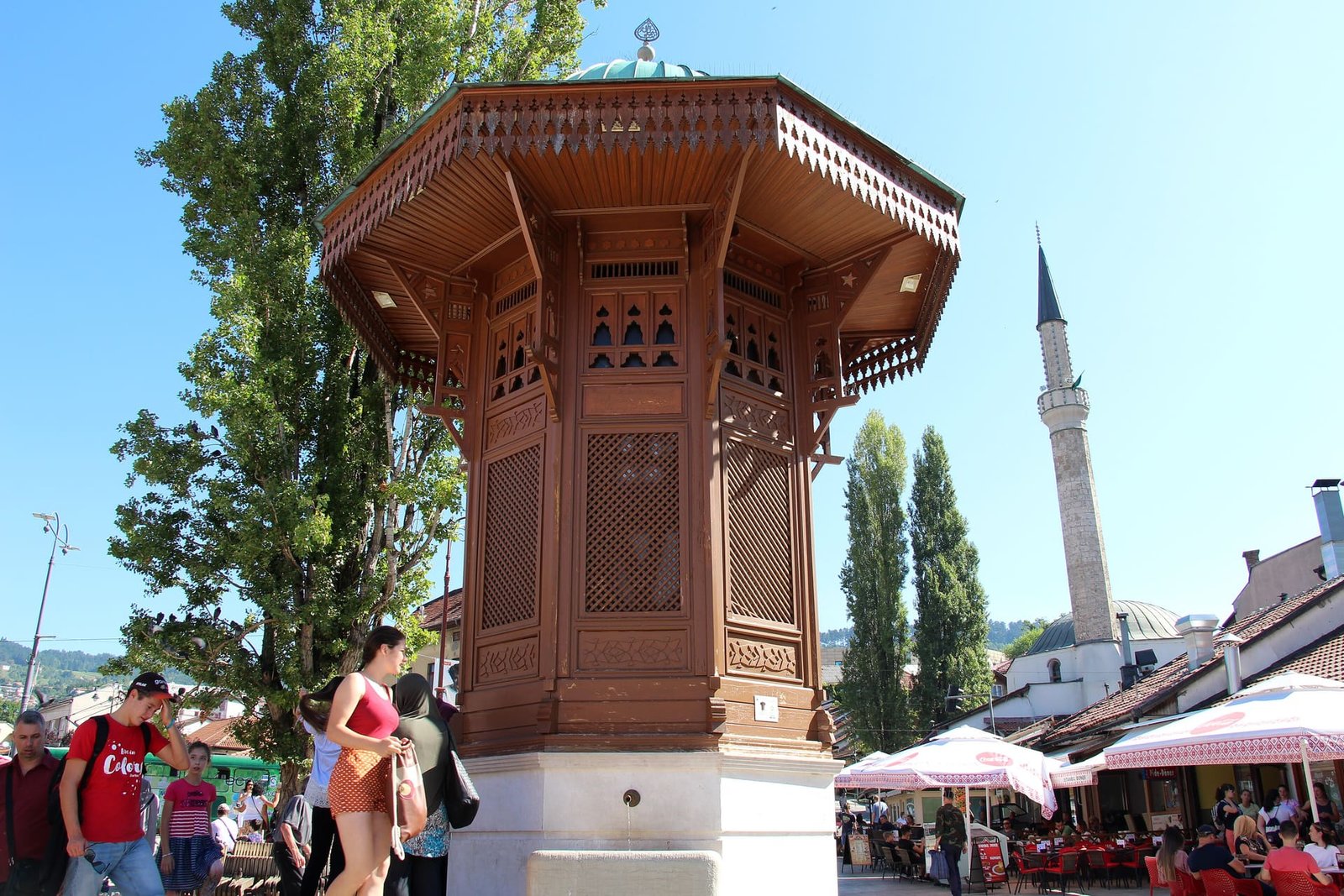
Spend the first day in and around Baščaršija, the 15th-century market quarter. Start at the wooden Sebilj fountain, wander the coppersmiths' street, step into the courtyard of the Gazi Husrev-beg Mosque, built in 1531, and walk down to the Latin Bridge, where Archduke Franz Ferdinand was shot in June 1914 and the First World War began. Lunch should be ćevapi - small grilled sausages in warm flatbread with raw onion - and the afternoon should involve at least one long Bosnian coffee. Finish at the striped, Moorish-style City Hall, burnt out in 1992 and beautifully restored.
Day two is for the city's more recent history and its views. The 1990s siege lasted nearly four years, and the War Childhood Museum and Gallery 11/07/95 tell that story with great care. In the afternoon take the Trebević cable car (30 KM return for visitors) up to 1,160 metres and walk to the abandoned Olympic bobsled track in the forest. Time your return for sunset at the Yellow Fortress, a ten-minute climb above the old town, where the whole valley lights up below you.
Day 3: the edges of Sarajevo
The sights on the outskirts are harder to link up on your own, and together they make an easy, varied day. Vrelo Bosne, the spring of the Bosna river, is a park of clear streams and swans at the foot of Mount Igman, reached along a three-kilometre avenue of plane trees. Nearby is the old Roman Bridge at Ilidža. Then comes the Tunnel of Hope, the hand-dug passage under the airport runway that kept the besieged city alive; a short section is open to walk through, and the entry fee is 20 KM, cash only.

From there the road climbs to Igman and Bjelašnica, the mountains of the 1984 Winter Olympics, for big views, clean air, and lunch in a mountain hut. This is exactly the loop our Spirit of Sarajevo tour covers in a day, and our guide to the historical sites around Sarajevo has the background.
Day 4: Travnik and Jajce
Most itineraries skip central Bosnia or tack it on as an optional extra. That is a mistake - this is the medieval heart of the country, and one of our favourite days out.
Travnik, about an hour and a half from Sarajevo, was the seat of the Ottoman viziers who governed Bosnia for 150 years. It has a hilltop fortress, the painted Coloured Mosque, and the birthplace of Nobel laureate Ivo Andrić, and its ćevapi are a matter of fierce local pride. Eat them beside the rushing stream at Plava Voda.
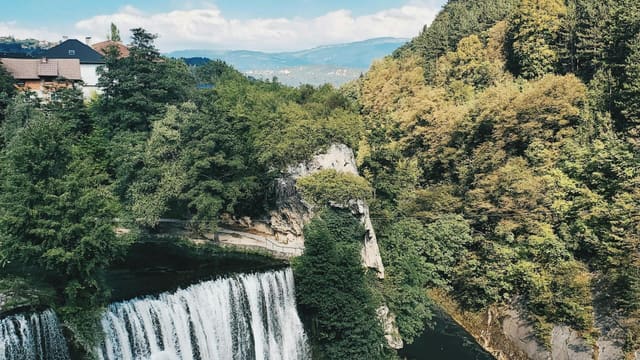
Another hour on is Jajce, the last capital of the medieval Bosnian kings, which fell to the Ottomans in 1463. It may be the only town in the world with a waterfall around 20 metres high in its centre, where the Pliva river drops into the Vrbas below the old walls. Climb to the fortress, look into the underground catacombs, then drive five minutes out to the Pliva Lakes, where a cluster of little wooden watermills stands on stilts over the channels between the lakes.

It is a long day - allow ten hours door to door - and the full route is in our Travnik and Jajce day trip guide. Buses do run to both towns, but not in a way that lets you see both and the lakes in a day. With a car it is straightforward, and it is the itinerary of our Central Bosnia tour.
Day 5: south to Mostar via Konjic
Today you change bases, and the journey is a highlight in itself. The road south crosses the Ivan pass and drops to Konjic, about an hour from Sarajevo, where a six-arched Ottoman bridge from 1682 spans the green Neretva.
Konjic also hides one of the strangest sights in the Balkans: Tito's bunker, a nuclear shelter built in total secrecy over 26 years to protect the Yugoslav leadership. It is now open for guided tours, usually at 9am, noon, and 3pm. You cannot simply turn up - visits must be reserved in advance and tickets, around 40 KM, are collected in town before the tour. Book this before you travel.

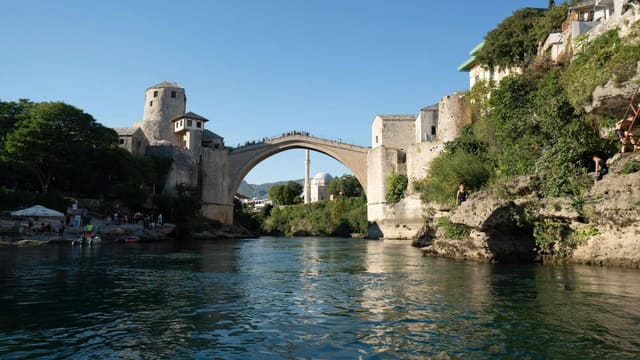
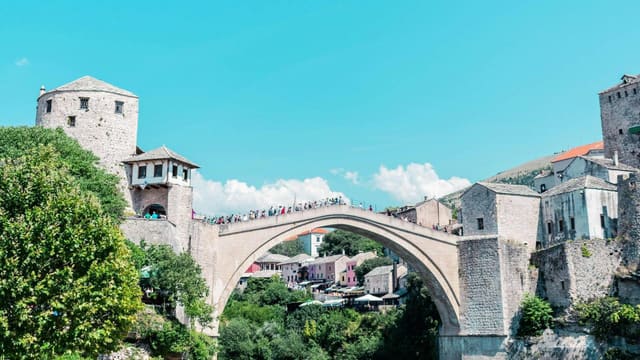
After Konjic the road follows the Neretva through its canyon, past Jablanica, which is famous for spit-roast lamb and makes the obvious lunch stop. You will be in Mostar by mid-afternoon, just as the day-trippers start to leave. Walk across the Stari Most, built in 1566, destroyed in 1993, and rebuilt stone by stone in 2004, and have dinner on a terrace facing it. The bridge at night, lit and quiet, is the reason to sleep here rather than visit for the day.
If you would rather not drive, the train from Sarajevo to Mostar is one of Europe's great cheap rail journeys - about two hours, around 14 KM, leaving Sarajevo at 7.15am and late afternoon. You will miss the bunker and the stops along the road, though, and a private transfer with a pause in Konjic gets you the best of both.
Day 6: Blagaj, Počitelj, and Kravice
The three best sights in Herzegovina all lie within an hour of Mostar, and they make a perfect loop. Start at Blagaj, 20 minutes away, where the Buna river pours out of a cave at the base of a 200-metre cliff beside a 16th-century dervish house. Go early, before the tour buses. Half an hour south, Počitelj is a fortified Ottoman village stacked up a hillside above the Neretva; climb to the tower for the view. Then on to Kravice, where the Trebižat river falls over a wide horseshoe of cliffs into a pool you can swim in from June to September. Entry is 20 KM, and the park stays open into the evening in summer.

None of the three is practical by public transport in a single day. Our Best of Herzegovina tour runs this loop from Mostar, and there is more detail on each stop in the Mostar day trip guide.
Day 7: a slow morning, then back
Get up early on your last day and have the old town to yourself. Climb the minaret of the Koski Mehmed-Pasha Mosque for the classic view of the bridge, browse the coppersmiths in the bazaar before the heat builds, and watch the divers limbering up on the parapet. Then head back to Sarajevo, a little over two hours by road, or take the afternoon train up the canyon for a last look at the Neretva.
The 5-day version
Short on time? Keep the two bases and trim the edges:
- Day 1 - Sarajevo. Old town, Latin Bridge, City Hall, sunset from the Yellow Fortress.
- Day 2 - Sarajevo and around. Tunnel of Hope and Vrelo Bosne in the morning, the museums or the Trebević cable car in the afternoon.
- Day 3 - Travnik and Jajce as a day trip.
- Day 4 - To Mostar via Konjic, evening on the Old Bridge.
- Day 5 - Blagaj, Počitelj, and Kravice, then return to Sarajevo in the evening, or stay a second night in Mostar.
If even that is too much, our Grand Herzegovina tour covers Konjic, Mostar, Blagaj, and Kravice in one long day from Sarajevo, which frees up a day elsewhere.
Got more time? Where to add days
With eight to ten days, these are the additions we would make, all within Bosnia and Herzegovina:

- Trebinje (about two and a half hours from Mostar). A handsome, sleepy town of plane trees and wine cellars in the far south, with the Tvrdoš monastery and its vineyards nearby. On the way, the Vjetrenica cave, added to the UNESCO list in 2024, and the medieval stećci tombstones at Radimlja near Stolac.
- Višegrad (two hours east of Sarajevo). The 16th-century Mehmed Paša Sokolović Bridge over the Drina, a UNESCO site and the star of Ivo Andrić's most famous novel.
- Sutjeska National Park (two hours southeast). Bosnia's highest peak, Maglić, and one of Europe's last primeval forests. A summer destination for hikers.
- Una National Park (three hours beyond Jajce). Emerald rivers and the thundering Štrbački buk waterfall in the far northwest. Beautiful, but far enough to need two extra days.
- Lukomir (about an hour and a half from Sarajevo, May to October only). The country's highest and most remote village, where shepherds still live in stone houses with cherry-wood roofs.

Practical notes
Driving times. Sarajevo to Mostar takes two to two and a half hours, Sarajevo to Travnik an hour and a half, Travnik to Jajce another hour, and Jajce directly to Mostar about three hours on mountain roads. Add a fifth to whatever your navigation app says. There is no motorway vignette; short stretches of motorway near Sarajevo are tolled at booths for a few marks.
Car or no car. A rental car runs from roughly 25 to 50 euros a day and gives you full freedom, but this route involves a lot of narrow, winding road. Many visitors do the cities on foot and leave the out-of-town days to a driver or a tour, which is how most of our guests travel. Winter equipment is compulsory from 1 November to 1 April.
Money. The convertible mark (KM) is fixed at about 1.96 to the euro. Cards work in hotels and most restaurants, but carry cash for museums, small cafes, parking, and market stalls - several of the main sights are cash only.
When to go. May, June, and September are ideal. Our month-by-month guide has the detail, and if you are coming in the cold months, see Bosnia in winter.
Let us plan it with you
Every day in this itinerary is one we run ourselves, and the simplest way to do the week is to mix and match: explore Sarajevo and Mostar on foot in your own time, and let us handle the days that need wheels and a guide. Tell us your dates and how long you have and we will shape the route around you - including hotel pick-ups, the transfer between Sarajevo and Mostar, and the Konjic bunker booking. Or browse our day tours and get in touch when you are ready. For the bigger picture of travelling here, start with our complete guide to tourism in Bosnia and Herzegovina.
Frequently Asked Questions